
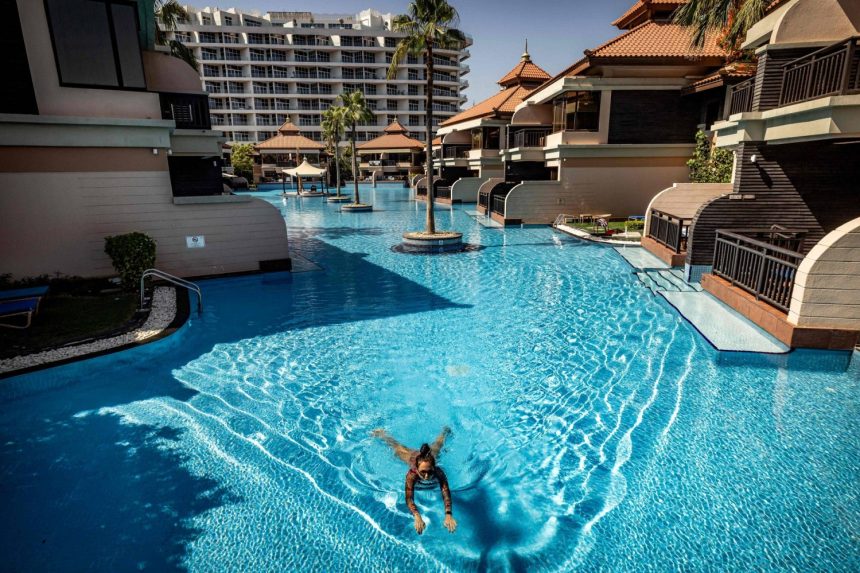
With foreign visitors staying away, the emirate’s five star hotels are filling their rooms with the people who already live here.
For years, a night at a Palm Jumeirah resort was a postcard sent home by visitors from London, Mumbai or Moscow. Today that same suite is just as likely to be booked by someone whose apartment sits twenty minutes down the road. Dubai’s most expensive hotels, suddenly short of the international crowd that once filled them, have turned to their own residents to keep the lights on.
The shift is dramatic. Before regional tensions flared, the emirate’s 827 hotels, among them 173 five star properties, ran at occupancy levels above 80 percent and welcomed roughly 19.5 million international guests a year. That pipeline thinned sharply after a US and Israeli strike on Iran on February 28 rattled the Gulf’s reputation for calm. Missile and drone exchanges that followed reached as far as hotels on the Palm and the Burj Al Arab. A ceasefire on April 8 cooled the fighting, yet the tourists have been slow to return.
Luxury, suddenly within reach
The hotels’ answer has been the staycation, sold hard to anyone who can show an Emirates ID at check in. Resident only packages now shave as much as half off suite rates, with deeper cuts attached to dining and spa add ons. For locals who once watched these properties from the outside, the math has changed overnight.
“Luxury in Dubai has become affordable for residents. Before, it was just for the rich, very rich people.”
That is how Fadi Iskandarani, a Lebanese physician in his sixties who has lived in Dubai for five years, described the new reality. He is exactly the guest hotels are chasing: someone with the means and the appetite for a weekend escape, and no need to board a flight to take one.
A lifeline, with limits
At the Anantara The Palm Dubai Resort, the pattern is easy to read on the booking sheet. General manager Michael Robinson said weekend occupancy now climbs to between 70 and 90 percent on Fridays and Saturdays, then sags to roughly 20 to 30 percent from Sunday through Thursday. The discounts, he said, have kept the property cash positive and spared it from layoffs.
70 to 90 percent weekend occupancy · 20 to 30 percent midweek · up to 50 percent off for residents
Still, Robinson is clear eyed about what local demand can and cannot replace. A resident booking is a short one, and short bookings do not add up the way a foreign holiday did.
“Your staycation business is essentially one to two nights and that is it. Whereas previously, the international market, they might come for one week.”
The gap shows up elsewhere too. Across the sector, some staff have absorbed pay cuts of around 40 percent, and others have been placed on stretches of unpaid leave lasting up to two months. The resident trade has bought time, not a full recovery.
Betting on patience
For now, Dubai’s hoteliers are running a holding strategy: keep the rooms warm, keep the staff employed where they can, and wait for the long haul visitor to feel safe enough to return. The discounts that look like a windfall to residents are, for the industry, a measure of how far the ground has shifted since late February.
Whether the staycation boom proves to be a bridge or a new normal will depend on something no marketing team controls, which is confidence that the Gulf is once again a place travelers can relax. Until then, the grandest suites in the city will keep their doors open for the neighbors.